
In industrial environments, every stage matters: from on-site handling to the final miles of international transport. Protecting components is critical, but today packaging must do more than simply perform. Operations directors and procurement managers need solutions that are efficient, sustainable and aligned with circular-economy objectives – without compromising performance or productivity.
Inviker’s 100% recyclable woven fabric-laminated paper has been engineered to meet this challenge. First presented at Advanced Manufacturing Madrid 2025 and selected as a finalist in the Advanced Manufacturing Awards 2025 (Sustainability and Circular Economy category), it combines industrial strength, operational versatility and genuinely straightforward recyclability.
Its design allows the paper and woven fabric layers to be separated after use, enabling their return to the production cycle and drastically reducing the environmental footprint of industrial packaging.

Table of content
What sustainable woven fabric-laminated paper brings to industry
Technical composition and material properties
This composite combines heavy-duty kraft paper with technical polyethylene (PE) woven fabric, creating a structure that delivers three essential properties for rigorous industrial processes:
- High puncture and tear resistance: crucial for metal components, heavy coils and bulky raw materials.
- Water resistance and humidity barrier, essential for long-distance maritime shipments or storage in variable climate conditions.
- Condensation absorption, the paper layer actively helps minimise internal moisture accumulation in sensitive loads.
These features ensure the material withstands intensive handling, transport vibrations and changing environmental conditions without losing structural integrity.
Real recyclability and clean material separation
Beyond the “recyclable” label, this material is engineered for practicality. The paper and woven fabric layers can be separated quickly and cleanly, either manually or mechanically.
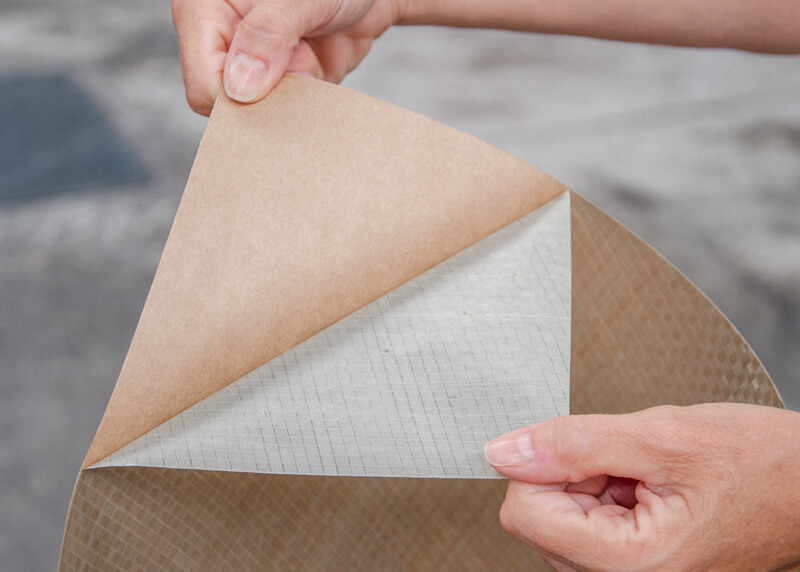
This allows purity levels of up to 95% to be achieved, making recycling through standard channels easier and significantly reducing industrial waste.
For companies with ESG commitments, this provides a tangible advantage: sustainability without higher operating costs or dependence on complex recycling infrastructure.
Proven applications in industrial packaging
The true value of recyclable woven fabric-laminated paper becomes evident on the production floor and throughout the logistics chain. Its applications focus on solving real technical packaging challenges by offering protection, efficiency and reliable performance.
Protecting critical components and materials
Coils, tubes, bars and metal sheets benefit from packaging that prevents tearing, scratching and abrasion, even under intensive transport conditions.
Its tensile strength supports the handling of heavy loads without compromising product integrity, providing reliability for demanding sectors such as steelmaking and metalworking.
Want to see how woven fabric-laminated paper performs with your components and workflows?
Request a test sample and we will advise you based on your specific application.
Inner lining and humidity control
When used as an inner lining for wooden crates or as a base layer on pallets, woven fabric-laminated paper acts as a robust barrier against external moisture. This is especially valuable in long-distance exports where temperature variations and humidity could corrode goods.
The porous paper layer aids in reducing condensation, protecting sensitive components during storage.
Application tip
Map the journey of your shipments to ensure the selected packaging provides the required level of protection. Consult with packaging specialists to identify the most suitable combination for your loads.
For critical shipments, this material can be complemented with VCI anticorrosive packaging or desiccant bags depending on logistic conditions.
Reinforcement and durable outer wrapping
A common use case involves placing the material beneath strapping, where the woven fabric-laminated paper prevents marking and deformation of the product.
As an outer wrapping, it improves resistance to abrasion and mechanical stress – ideal for industrial components with irregular shapes or delicate surfaces.
Optimisation in handling, logistics and packaging lines
Its flexibility and strength make it suitable for both manual and automated packaging lines.
It can be supplied in rolls or custom-cut formats, optimising material usage and improving plant efficiency.
In addition, it integrates seamlessly with pallets, wooden crates, strapping and supplementary protective materials, allowing for immediate adoption and seamless integration without major process changes.
Integration into existing workflows
Woven fabric-laminated recyclable paper fits easily into standard industrial packaging processes:
- Compatible with existing cutting, handling and packaging lines.
- Available in industrial rolls for high-volume operations or in custom sheets for specific spare parts.
- Suitable for multilayer packaging strategies, allowing you to add or remove protection based on the specific transport risk.
This practical approach enables B2B companies to maintain productivity while moving towards circular-economy models without complex adjustments on site.
Target sectors and use cases
Sustainable woven fabric-laminated paper provides high value in sectors handling critical loads with strict safety requirements and sustainability-focused traceability.
Automotive: protection for metal components, machined parts and export-bound assemblies.
Steel and metalworking: reinforcement for heavy loads, abrasion prevention for stainless steel sheets, aluminium profiles and wire coils.
Industrial machinery: protection for high-value components, bulky items or moisture-sensitive spare parts.
Its recyclability helps reduce waste, support ESG indicators and close the material loop with full traceability.
Inviker’s 100% recyclable option of paper with woven fabric demonstrates that environmental responsibility and industrial performance can move in the same direction. It protects valuable assets, adapts to multiple packaging processes and adds measurable value to any circular-economy strategy.
For companies seeking to reduce their environmental impact without compromising product safety, it offers a practical, reliable and easy-to-integrate solution.
Ready to optimise your packaging line?
If you would like to assess how this material can be implemented in your specific operations, Inviker provides tailored advice and samples adapted to each application.